How Much Does It Cost to Build a Multi-Vendor Marketplace in 2026?
06 Oct, 2026



Learn how to build a multi-vendor marketplace website in 2026. Explore core workflows, essential customer, vendor, and admin features, step-by-step development process, and cost factors.
In 2026, the eCommerce landscape continues to shift rapidly from single-retailer web stores toward multi-sided digital platforms. A multi-vendor marketplace website brings independent sellers and buyers together within a unified digital storefront. Rather than purchasing and stocking inventory yourself, you provide the catalog infrastructure, payment processing, vendor management, and trust mechanisms—earning commission on every transaction that takes place across the platform.
Global retail leaders like Amazon, Etsy, and Alibaba have proven the power of this business model. However, high-growth opportunities exist within focused vertical markets—including regional artisan goods, B2B industrial supplies, niche electronics, boutique fashion, and specialized services. If you are planning how to build a multi-vendor marketplace website in 2026, this practical guide outlines the core architecture, operational workflows, essential feature sets, development milestones, cost drivers, and build-versus-buy trade-offs required to launch successfully.
A successful multi-vendor marketplace is not merely an online shop with multiple accounts. It is a four-sided ecosystem coordinating customers, vendors, platform infrastructure, and administrative governance through automated split payments, real-time catalog indexing, and transparent order tracking.
At its core, a multi-vendor marketplace is an eCommerce platform where multiple third-party merchants (vendors) sell their products or services directly to consumers or business buyers through a single centralized domain. The marketplace operator provides the digital environment, search engine visibility, payment gateways, and dispute resolution mechanisms, while vendors maintain autonomy over their product listings, inventory levels, and order fulfillment.
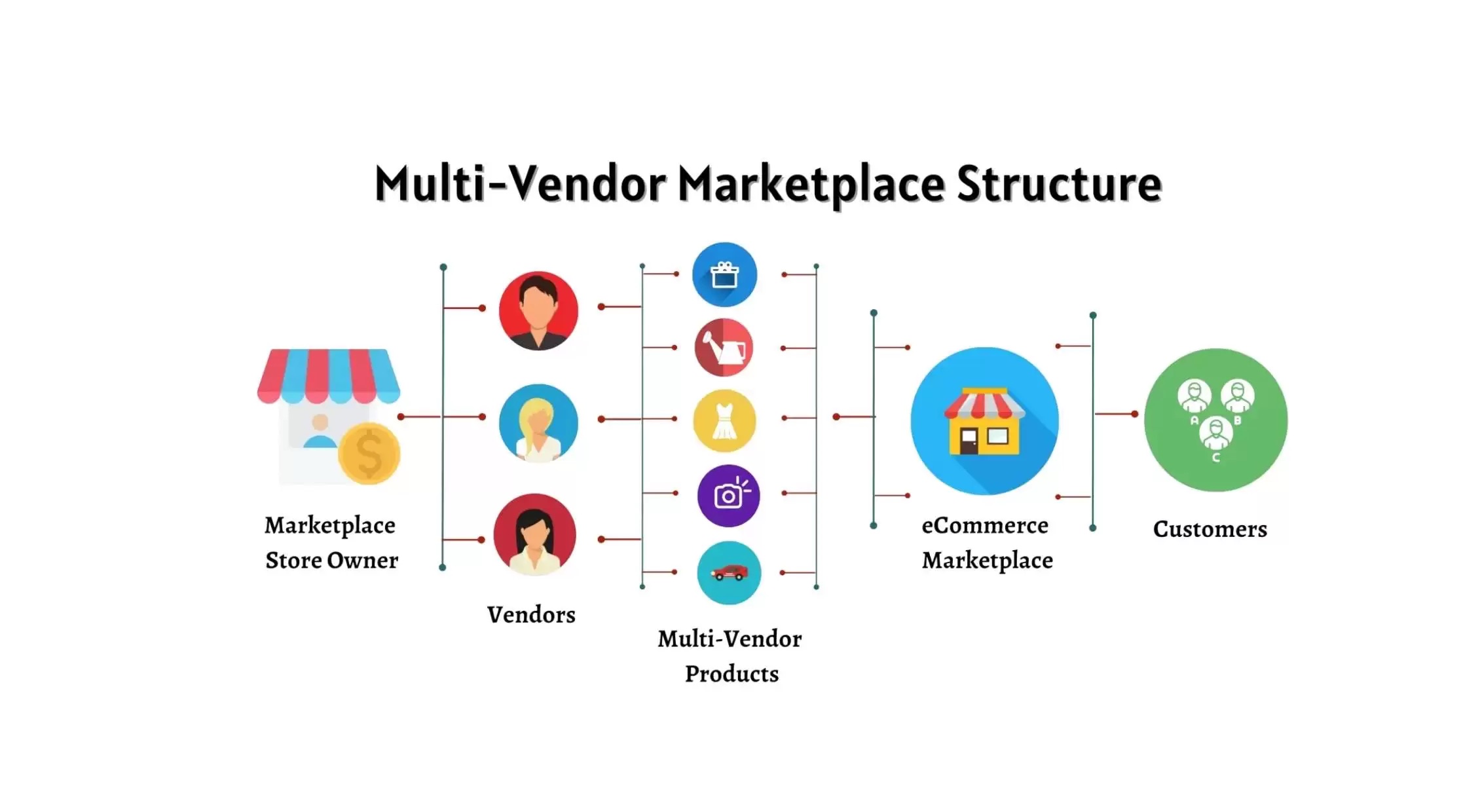
To understand how modern marketplace software operates, consider the four primary participants in the marketplace ecosystem:
Browses unified catalogs, adds items from multiple sellers to a single shared cart, pays via secure checkout, and tracks shipments until delivery.
Manages their branded storefront, uploads product details and pricing, monitors stock, fulfills incoming orders, and receives automated net payouts.
The underlying technology layer handling search indexing, session management, automated payment splitting, commission deductions, and security.
Governs the ecosystem by vetting vendors, moderating listings, configuring commission rules, reviewing analytics, and resolving disputes.
From the outside, a multi-vendor marketplace functions with the simplicity of a standard online store. Behind the scenes, however, the platform executes a synchronized order-routing and split-settlement sequence across several independent databases:
When planning marketplace website development, organizing feature requirements by user role ensures clarity during both UI design and backend engineering:
Engineering a scalable multi-vendor eCommerce platform requires a disciplined engineering roadmap. Following structured development phases ensures your platform launches on time without technical debt:
Decide how your marketplace generates income: sales commissions (e.g., 5% to 15%), recurring monthly vendor subscriptions, listing fees, or sponsored product placements. Identify your niche market to validate that vendor supply and consumer demand exist.
Map out relational database tables isolating customer records, vendor storefronts, master product catalogs, sub-orders, and financial audit logs. Clear role-based access control (RBAC) prevents vendors from viewing competitors' sensitive sales data.
Design high-fidelity mockups for customer shopping flows, merchant onboarding screens, and administrative consoles. Prioritize a mobile-first interface with intuitive category navigation, simplified checkout, and legible order summaries.
Engineers write clean source code for the frontend UI (using Blade, React, or Vue) and backend application services (typically Laravel, Node.js, or Go) backed by relational databases such as PostgreSQL or MySQL. Explore TechXons' custom software development services for tailored implementations.
Implement payment gateways configured for automated multi-vendor disbursement. Webhooks handle instant payment verification, automated fee deduction, and refund handling without manual administrative intervention.
Execute automated unit tests, integration tests across multi-vendor cart combinations, and simulated peak traffic load tests. Verify SSL certificates, CSRF tokens, database sanitization, and strict input validation.
Deploy on scalable cloud infrastructure with containerization, Redis caching, and global CDN delivery. For ongoing stability, leverage TechXons' server deployment and management protocols.
Development costs for a multi-vendor marketplace website vary considerably based on the project's technical scope, feature complexity, and architectural approach. Rather than relying on arbitrary price tags, business owners should evaluate the key engineering factors that drive project investment:
For an in-depth breakdown of software estimation factors and budgeting methodology, read our guide on the cost to develop a custom business app in 2026.
When launching an online marketplace, founders face a foundational strategic choice: buy off-the-shelf software, customize a proven turnkey solution, or engineer a bespoke platform from scratch. Here is how these three paths compare:
| Dimension | Ready-Made Turnkey Script | Customized Turnkey Solution | Bespoke Custom Engineering |
|---|---|---|---|
| Time to Market | Fastest: Core marketplace logic, vendor panels, and templates deploy in days. | Balanced: Foundational logic deploys quickly; customized features added iteratively. | Extended: Full software development lifecycle spanning months of custom engineering. |
| Initial Investment | Lowest upfront cost; ideal for market concept validation. | Moderate investment focused strictly on high-value custom modules and branding. | Higher upfront capital commitment for dedicated development team hours. |
| Customization Freedom | Configured within built-in marketplace settings and theme options. | High flexibility; core source code modified to support unique business logic. | Complete freedom; every database table, API, and UI element built from scratch. |
| Best Suited For | Entrepreneurs validating demand in standard retail or digital niches. | Businesses seeking accelerated launch combined with custom payment gateways or branding. | Enterprise retailers with non-standard legacy ERP integrations and strict proprietary requirements. |
For businesses seeking accelerated market entry without sacrificing quality, starting with our production-ready Amazon clone marketplace platform or exploring our wider catalog of ready-made software solutions provides a balanced approach. It establishes verified multi-vendor operations immediately, while keeping open the ability to extend functionality via custom development.
In modern software development conversations, the terms "Amazon-like marketplace" and "Amazon clone" are often used interchangeably, but there is an important practical distinction to understand:
When a business aims to create an Amazon-like marketplace, it seeks to replicate the familiar, user-tested operational mechanics that make Amazon effective—such as a unified multi-seller storefront, centralized search with faceted filters, automated split checkouts, and merchant dashboards. It does not mean copying Amazon’s registered trademarks, brand assets, proprietary code, product listings, or copyrighted visual design.
In contrast, a turnkey Amazon clone script refers to a commercial software package engineered from the ground up with independent source code to deliver these familiar multi-vendor eCommerce workflows out of the box. As explored in our comprehensive guide on website cloning methodology, legitimate cloning projects build independent software based on proven concepts, with code ownership and licensing terms defined according to the project agreement.
TechXons provides comprehensive software engineering and technical consulting services to guide businesses through every stage of online marketplace development. Whether you require bespoke custom development or an accelerated turnkey launch, our team offers:
A multi-vendor marketplace website is an eCommerce platform where multiple independent third-party merchants register, upload catalogs, and sell goods to consumers or businesses. The platform operator coordinates catalog discovery, payment splitting, and dispute governance, earning revenue via transaction commissions or fees.
Marketplaces monetize through various complementary models: charging a commission percentage per completed order, offering monthly vendor membership subscriptions, collecting listing fees for premium catalog placement, charging for featured banner ads, and offering value-added logistics or fulfillment services.
A comprehensive multi-vendor platform requires three coordinated portals: a customer storefront (faceted search, shared multi-vendor cart, secure checkout, live order tracking), an autonomous vendor portal (product upload, inventory controls, order fulfillment, payout ledger), and a super admin console (vendor KYC approval, commission configuration, product moderation, global reporting).
Delivery timelines depend directly on your development path. Deploying a ready-made turnkey marketplace solution with customized branding and local payment keys typically takes 1 to 2 weeks. Customizing a turnkey foundation with specific regional modules ranges from 3 to 6 weeks, while engineering a bespoke enterprise marketplace from the ground up generally requires 3 to 6 months.
Cost is governed by functional requirements, including whether native mobile apps are needed, the number of distinct user roles, payment gateway complexity, custom ERP or shipping integrations, and scalability targets. Turnkey software foundations offer significant cost savings compared to fully bespoke custom builds.
Yes. High-quality marketplace software is built with modular architecture, unencrypted source code, and clean API endpoints. Development teams can easily customize branding, add localized payment gateways, adjust commission structures, or adapt workflows to B2B, wholesale, or niche retail models.
If your target market follows standard multi-vendor eCommerce workflows and fast market entry is a priority, a ready-made turnkey solution provides the most practical and cost-effective approach. If your operational workflows require proprietary algorithms, non-standard logistics, or integration into legacy enterprise databases, custom software development is recommended.
Yes. Modern marketplace architectures utilize RESTful or GraphQL APIs connecting a centralized database to both responsive web applications and native iOS and Android mobile apps for customers, vendors, and delivery couriers.
Whether you are deciding between a ready-made marketplace solution and bespoke custom software, TechXons provides experienced technical consulting, full-stack engineering, and unencrypted source code ownership to bring your digital platform to life.